


We’ve all probably heard it before: “Hello, ladies and gentlemen.” For many people, this phrase often goes unnoticed, but for trans and non-binary people, it can trigger a dysphoric feeling. So, how can we make sure to address everyone in an inclusive and pleasant way? By using inclusive language and gender-neutral words! Why is this so important? Using inclusive language ensures no one is left out and everyone feels part of what you say or write. But what exactly does “gender-neutral” and “inclusive” mean? It depends on the context and the relationship you have with the person.
Switching to general language
Do you write emails or texts, or speak in front of groups? Avoid words like “ladies and gentlemen,” “boys and girls,” or “Ms.” and “Mr.” Using just these words excludes a whole group of people. Instead, use inclusive alternatives, such as “people,” “folks,” or “everyone.” You can also address people by their role or function, such as “students,” “colleagues,” “guests,” or “travellers.” This way, you address people without assigning a gender, which is inclusive language!
Also, much of our language is written in male form, and we don’t always know how to avoid this. Below are different ways to rephrase gender-related words or avoid them altogether. For example, you can choose a plural form:

You can also choose an article instead of a male possessive pronoun:

And then there’s the option to use ‘they’, which is already a neutral term in general language.

In addition to the examples mentioned above, there are plenty of other ways to rephrase your sentences in a more inclusive language. It might feel a bit strange at first, but the more conscious you become of it and the more often you use it, the easier it will be to get the hang of it!
Gender-free family terms
Family terms are also often gender-based. For example, “father/mother,” “brother/sister,” “uncle/aunt,” “grandfather/grandmother,” “nephew/niece.” All of these words are tied to a specific gender, and many trans and non-binary people feel uncomfortable with them. To make it easier, we’ve created a list of inclusive/gender-neutral alternatives. Don’t hesitate to get creative and come up with words that feel right for you as a trans or non-binary person!
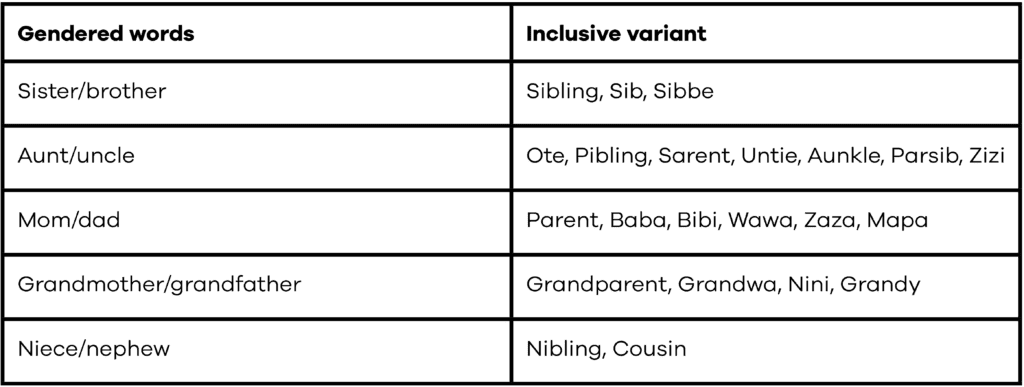
In some situations, there aren’t yet neutral or inclusive words. Especially in the Dutch language, we’re still catching up with creating new, inclusive terms. Take a moment to think about this and try coming up with new words yourself. After all, language is something we create together!
Speak up for inclusive language
Do you often hear other people use gendered words that make you feel uncomfortable, as an ally or a trans/non-binary person? Don’t hesitate to speak up and explain why it’s important to use inclusive language.